What Is Your Household's Profit Margin? The Number Businesses Live By, Applied to Your Own Money
Companies report a number every three months that decides whether investors get excited or worried about that business. Your household already has the exact same number - you've just never been taught to look for it.
It's called profit margin, and once you see how it applies to your own paycheck, it becomes one of the clearest ways to understand your own finances.
What Profit Margin Actually Means - Using Your Own Numbers
Let's use a real household to make this concrete. Say a household brings in $5,000 a month after taxes. In business terms, that $5,000 is the household's revenue - all the money coming in.
Now subtract the biggest expense most households have: rent or a mortgage payment. Let's say that's $1,500 a month. After just that one expense, there's $3,500 left.
That's profit margin, in its simplest form: what percentage of the money coming in is actually left over, after expenses are paid? Right now, after just rent, this household is keeping 70 cents of every dollar it earns. That's a 70% margin - but rent is only one expense. Real life has more than one.
Let's keep going and add the expenses that quietly eat into that margin every month:
- Groceries: $600
- Car payment and gas: $500
- Insurance: $300
- Subscriptions and streaming services: $80
- Credit card or loan payments: $400
- Eating out and miscellaneous spending: $450
Add those to the $1,500 rent, and total expenses come to $3,830. Subtract that from the $5,000 in income, and this household has $1,170 left over each month.
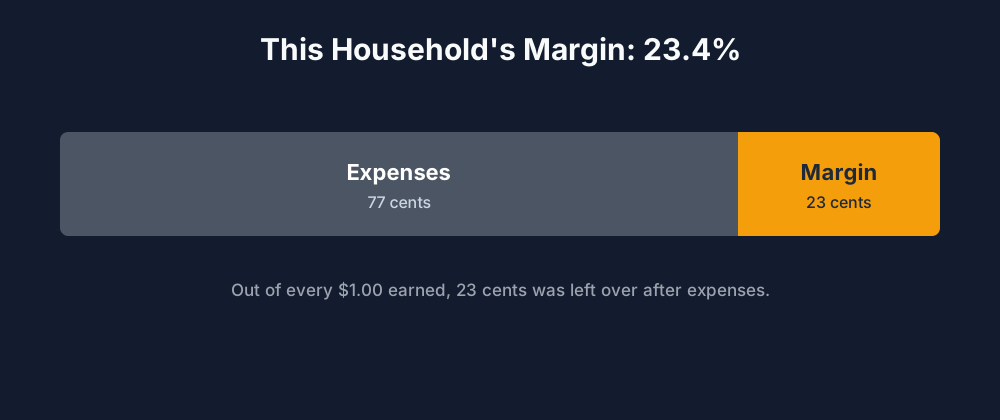
Whatever isn't spent is the household's margin - the same idea as a company's profit margin, just with different expense categories.
That's a real, calculated, meaningful number, exactly the kind of number a business would report to its investors. The only difference is nobody's asking your household to report it - which is exactly why most people never calculate it in the first place.
Why Businesses Care About This Same Number
Companies run this identical calculation, just with different expense categories - materials, salaries, rent on office space, marketing, interest on loans, and taxes, instead of groceries and car payments. The math doesn't change, only the line items do.
This number matters enormously to investors. When a company's margin is healthy and steady, investors feel confident. When it starts shrinking or jumping around unpredictably, investors get nervous, and that nervousness often shows up directly in the stock price. A company that finds a way to grow its margin over time - keeping more of each dollar as it gets bigger - is usually seen as becoming more efficient or gaining a real edge over competitors.
It's worth being honest, though: margin is one major piece of the puzzle for a stock's price, not the entire puzzle. How fast a company is growing and how risky its business is can move a stock price too, sometimes faster than margin does. But margin remains one of the clearest, most-watched signals of whether a business is actually healthy.
That's the same exact signal for your household. A healthy, growing margin means you have room to save, invest, and handle a surprise expense without panic. A thin or shrinking margin, even if your income looks fine on paper, is often the first real warning sign that something needs attention.
Where Most Households Actually Stand
That 3.6% figure is the real-world version of household margin, measured across the whole country. For comparison, many financial planners suggest aiming for something closer to 20% of take-home pay as a savings target. That means most households are running a margin roughly five times thinner than that target.
The household example earlier in this article, with its 23.4% margin, is actually doing quite well by comparison. But notice something important: that number only exists because every expense was written down and added up. Without that step, there's no way to know the real margin - just a vague feeling of "things are tight" or "things are fine."
Finding Your Own Household Margin with Budget Builder
This is exactly what the free Budget Builder tool is built for. Once you enter your income and your expenses, it shows you three numbers in real time: Total Income, Total Expenses, and a Net Surplus or Deficit line that is, in plain terms, your household's margin. No spreadsheet, no manual subtraction - the number is just there, updating as you go.
But the more useful part isn't just seeing the final number. It's what the tool does underneath it: every expense gets sorted into a bucket - Bills, Subscriptions, Flexible Spending, or Debts - and broken down visually. That breakdown is what actually lets you find the answer to the question that matters most: if my margin needs to be wider, where would that even come from?
Without that breakdown, "cut back on spending" is just vague advice nobody can act on. With it, you can see in seconds whether your Flexible Spending bucket is unusually large compared to your Bills, or whether Subscriptions have quietly grown into a bigger chunk than you'd guess. That's the difference between a feeling and a fact - and facts are what make a real decision possible.
This is also where the tool becomes useful for more than just one person. If you share finances with a partner, sitting down together with the category breakdown turns a money conversation that's usually vague and a little tense into something concrete. Instead of "I feel like we spend too much eating out," the bucket breakdown can simply show whether that's actually true, and by how much. The conversation moves from opinions to numbers - and numbers are a lot easier to agree on.
None of this requires a finance background. The math itself is simple. What's actually been missing for most households isn't the ability to do the subtraction - it's having the buckets drawn clearly enough to know what to look at in the first place.
See Where Your Margin Is Going
Budget Builder breaks your spending into clear categories, so you always know exactly where your household margin stands - and what to talk about if it needs to change.
Start Free